Shining in International Competition
The Chinese Bridge competition is an international event celebrating Chinese language and culture. Among them was BYU sophomore Ashley Breinholt, who finished second.

Philanthropies
1450 N. University Ave
Provo, UT 84604
801-356-5300
Email Us


May 2026
When Jake Jackson read that he would be serving a Hmong-speaking mission in Minnesota for The Church of Jesus Christ of Latter-day Saints, he was confused. He had never heard of Hmong. He was even more puzzled when he learned that there was a Hmong community near his hometown of Delta, Utah.
“My mom grew up with friends whose families had resettled in the area after the Vietnam War,” says Jackson. He is now a junior studying international relations and Hmong at BYU.
In addition to teaching Hmong 101, Jackson works as a research assistant, translating interviews on Hmong culture and economy. His language skills have led him to become a certified interpreter for the US Department of Justice and an interpreter for general conference sessions of The Church of Jesus Christ of Latter-day Saints.
Jackson is one of more than 20,000 thousand BYU students (more than 60 percent) who speak a second language—remarkably, more than 121 languages are spoken on campus.
BYU’s language initiatives have accelerated and excelled since Church President Spencer W. Kimball said in his 1975 second-century address: “BYU should become the acknowledged language capital of the world.”
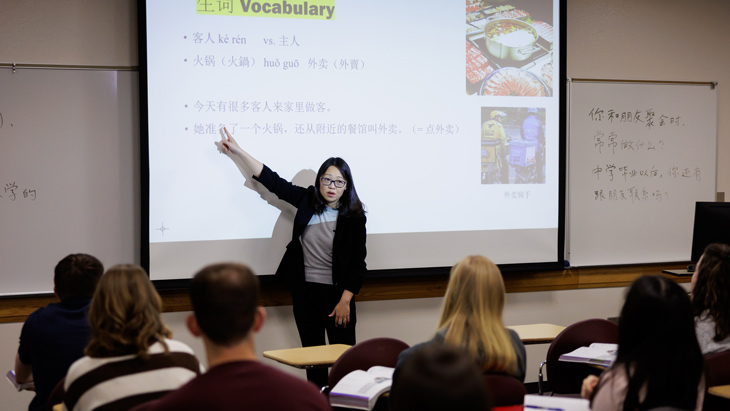
According to the most recent Modern Language Association (MLA) survey, BYU ranks first nationally in both language course offerings and advanced language enrollments. In addition, there are opportunities for students to earn language certificates, gain immersive language experiences, and collaborate with professors on peer-reviewed language research.
The Center for Language Studies (CLS) is the hub for language learning and teaching at BYU. “We have an amazing team here,” says Ray Clifford, CLS director, and an associate dean in the College of Humanities. “Our center supervises 80 teachers, and that is in addition to languages taught in the language departments; everybody puts forth so much effort.”
BYU now offers an astounding 84 non-English language courses, which is more than any other US university. In the MLA survey, Harvard ranks second with 78 languages and UC Berkeley ranks third with 59 languages. Among BYU’s offerings are some of the world’s rarer languages, including Hmong, Navajo, Kiribati, and a few Central American indigenous languages.
BYU has the highest number of students enrolled in advanced language courses in the US.
Returned missionaries contribute to this high number. Clifford explains that returned missionaries are usually half-proficient in their mission languages.
All BYU students, regardless of their majors, can earn a language certificate by demonstrating high language proficiency. Language certificates, available in 24 languages, are awarded by CLS based on completion of upper-level language courses and proficiency ratings certified by ACTFL, a language-proficiency testing organization. The CLS awards more than 500 certificates each year to students from 120 majors across campus.
BYU uniquely offers year-round immersive housing for students who want to increase their language confidence and proficiency. Also, BYU offers 127 study abroad and internship programs that are language adjacent through the David M. Kennedy Center for International Studies.
Fiona Bates, who studied French, Spanish, and Chinese at BYU, used study abroad experiences to deepen her understanding of our common humanity. She served Alzheimer’s patients in France, interacted with people along the Camino de Santiago pilgrimage route in Spain, and completed intensive Mandarin training in Taiwan.
She says. “I’ve learned that there is so much we have in common with other people . . . I think [understanding that] is beautiful.” Bates now works as a medical interpreter at a pediatric hospital.
On campus there is significant research into language and the brain. The Language Sciences Laboratory is equipped with research tools including fNIRS, EEG, eye-tracking devices, and sound isolation booths.
Ellen Knell, associate director of CLS, and her graduate students even involve local high schoolers in research. “The fNIRS technology is transportable—a cap you put on the head,” she says. “We take this technology into schools to learn about language proficiency and age.”
Linguistics professors are at the forefront of BYU’s language research. Recently, Jeff Green has published studies in Brain and Language on perception and American Sign Language, as well as an eye-tracking study on Chinese character processing in Language Awareness. In addition, Studies in Second Language Learning and Teaching recently published Dan Dewey’s research examining heart rate variability and personality traits as predictors of Arabic language proficiency.
Language and language learning are fundamentally about relationships, explains Christopher Oscarson, dean of the College of Humanities.
“We form unique ties by communicating in another person’s native tongue, and additionally, we are ourselves changed by the experience of learning languages; language learners develop charity, patience, humility, perspective and gratitude as they extend the limits of their imagination to embrace others and their world views,” Oscarson says. “Simply put, learning languages can help us to be more Christlike and prepare us to serve others.”

The Chinese Bridge competition is an international event celebrating Chinese language and culture. Among them was BYU sophomore Ashley Breinholt, who finished second.

Savannah Jepson conducted a study of accents in Lapoint, Utah. “I’m the only linguist I know of that has conducted sociolinguistic research in the Uintah Basin.”

Humanities student gains cultural, language, and spiritual growth through internship with the Spanish Ministry of Education.